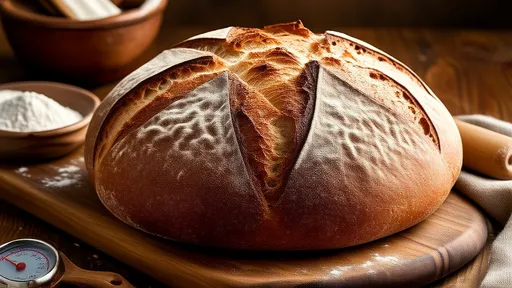
The art of crafting the perfect hard-crust European loaf hinges on a delicate balance of moisture control during baking. Among the most critical yet often overlooked factors is steam management – or more precisely, the consequences of insufficient steam during the initial oven spring phase. Bakers chasing that iconic blistered crust and open crumb are discovering that thickness and texture are profoundly influenced by how hydration interacts with heat in the first ten minutes of baking.
When oven humidity falls short, the dough’s surface dries prematurely, forming a rigid barrier that restricts expansion. This results in a thicker, denser crust as the loaf’s internal steam struggles to escape. Artisan bakers refer to this as the "early-set crust phenomenon," where inadequate external moisture causes the outer layer to harden before the bread achieves full volume. The effect is particularly pronounced in lean doughs with hydration levels below 72%, where the limited free water accelerates surface dehydration.
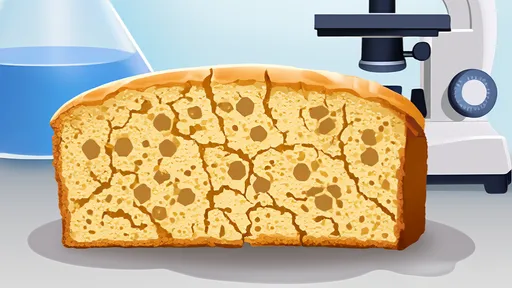
Experiments in steam-deficient environments reveal fascinating microstructural changes. Crusts develop up to 40% thicker compared to properly steamed loaves, with a compressed cell structure near the surface. This occurs because trapped moisture from the crumb migrates outward but condenses beneath the hardened crust, creating a moisture gradient that alters starch gelatinization patterns. The result? A leathery intermediate layer that lacks the crisp fragility of a traditionally baked sourdough.
Seasoned bakers combat this through strategic hydration adjustments. Some maintain higher dough hydration (75-78%) to compensate for oven steam shortcomings, while others employ alternative steaming methods like soaked baking stones or ice cube trays. The most innovative approach involves pre-bake misting with different water temperatures – cold water creates longer-lasting steam, while hot water produces immediate humidity but dissipates faster.
The relationship between steam deprivation and crust thickness isn’t linear. Research indicates a threshold effect: below 20% relative humidity in the oven’s initial phase, crust thickness increases exponentially. This explains why home bakers often struggle with dense crusts despite following professional recipes – domestic ovens rarely achieve the 35-40% humidity range of deck ovens. The solution lies in understanding your oven’s steam retention capacity and adjusting dough hydration accordingly.
Beyond thickness, insufficient steam affects crust coloration and blister formation. Without adequate moisture keeping the surface pliable, Maillard reactions occur unevenly, leading to patchy browning. The lack of surface tension also inhibits proper blister development, resulting in fewer but larger blisters that lack the delicate, glass-like quality prized in artisan circles. This explains why steam-injected oven loaves display more uniform micro-blistering across the entire surface.
Water’s role extends beyond steam generation. The mineral content of water used in both dough and steaming significantly impacts crust characteristics. Hard water (150-300 ppm calcium carbonate) tends to produce thicker, more resilient crusts due to strengthened gluten networks, while soft water yields thinner but more brittle shells. Some avant-garde bakers now experiment with mineral supplements in their steaming water to manipulate crust texture independently of dough formulation.
The most surprising finding concerns retrogradation – the recrystallization of starch molecules after baking. Steam-deprived crusts exhibit accelerated retrogradation, becoming harder and more brittle within hours of cooling. This explains why bakery breads maintain better texture over time – their properly steamed crusts have a more balanced starch structure that resists over-drying. Home bakers can mitigate this by wrapping loaves in linen while cooling, creating a microclimate that slows moisture redistribution.
Modern baking science continues to unravel steam’s complexities. High-speed thermal imaging reveals that even brief steam interruptions during oven spring cause visible crust thickening. Meanwhile, acoustic analysis shows steam-optimized crusts produce higher-frequency sounds when tapped – a reliable quality indicator. These high-tech insights confirm what traditional bakers knew empirically: controlling moisture flux is the invisible hand shaping every perfect crust.
As hearth bread regains popularity, understanding these moisture dynamics becomes essential. The difference between a good loaf and a great one often lies in those first minutes of baking, where water exists in all three states – liquid in the dough, vapor in the oven, and ice in alternative steaming methods. Mastering these phase changes unlocks the secret to crust perfection, proving that in bread baking as in life, sometimes it’s the invisible elements that matter most.
By /Jul 17, 2025
By /Jul 17, 2025
By /Jul 17, 2025
By /Jul 17, 2025

By /Jul 17, 2025

By /Jul 17, 2025
By /Jul 17, 2025

By /Jul 17, 2025
By /Jul 17, 2025
By /Jul 17, 2025
By /Jul 17, 2025
By /Jul 17, 2025
By /Jul 17, 2025
By /Jul 17, 2025

By /Jul 17, 2025

By /Jul 17, 2025
By /Jul 17, 2025
By /Jul 17, 2025
